Case study · Healthcare
Pericare
Maternal and child health platform combining a mobile-facing API and an internal admin dashboard for content, commerce, and operations.
- Role
- Full-Stack Software Engineer
- Timeline
- 05/2025 — 08/2025 · Contract
- Scope
- Mobile API + admin dashboard
Overview
The problem
Product, content, subscriptions, and partner workflows needed to be managed in one reliable system while supporting real user-facing healthcare journeys.
My role
Full-stack ownership across backend architecture (NestJS + Prisma) and the admin experience (TanStack Start + React), with a focus on operational clarity and delivery speed.
Constraints
- 01
Support Firebase-authenticated users and admins with strict route-level access boundaries.
- 02
Keep Shopify and RevenueCat integrations stable while evolving data models and dashboard workflows.
- 03
Ship safely across a growing set of modules: users, learning content, events, products, partners, banners, nursing spaces.
Decisions
- 01
Modular domain services with admin, public, and webhook separation, sharing pagination and DTO conventions.
- 02
Prisma migrations for schema evolution, keeping feature rollout incremental and traceable.
- 03
Provider-based media and CDN handling to avoid lock-in and support future storage backends.
Impact
- 01
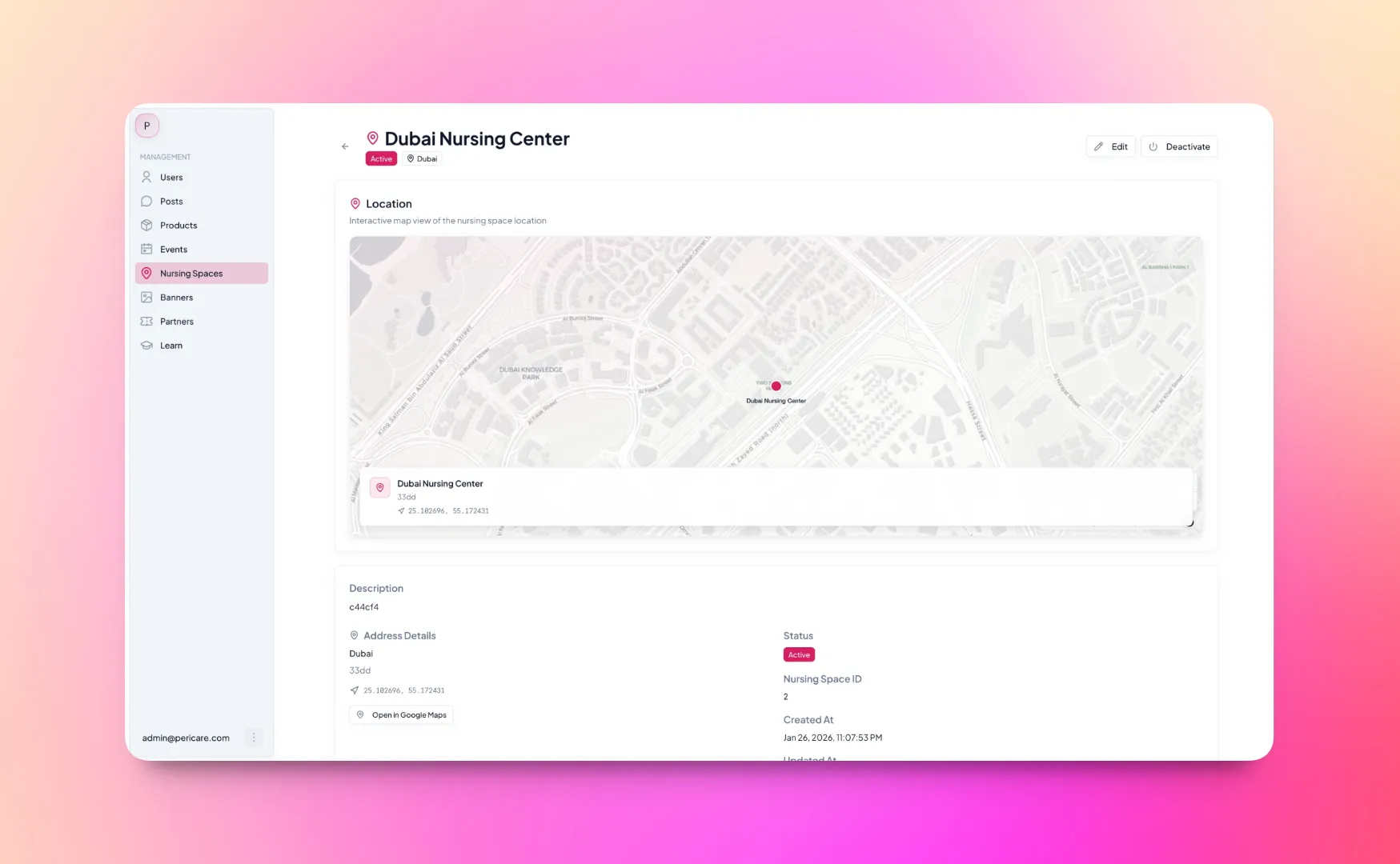
One admin surface for users, educational content, products and events, partners and codes, banners, and nursing spaces.
- 02
A scalable integration layer for subscriptions and commerce events via RevenueCat and Shopify webhooks.
- 03
More consistent operations through shared table and query patterns with cursor pagination across modules.
Stack
- TypeScript
- React
- TanStack Start
- Tailwind CSS
- TanStack Query
- TanStack Table
- NestJS
- Prisma
- PostgreSQL
- Firebase
- Shopify Webhooks
- RevenueCat Webhooks
Lessons
- 01
Domain-heavy platforms benefit from clear module boundaries early.
- 02
Webhook-driven systems need explicit contracts and backfill tooling to recover from integration drift.